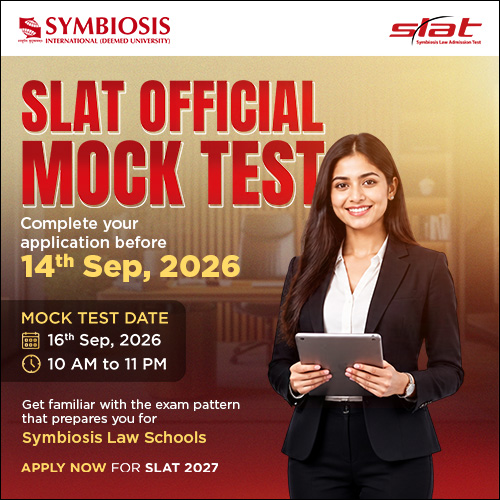
The Symbiosis Law Admission Test (SLAT) is a popular law entrance exam for students across India. It grants admission to reputed Symbiosis Law Schools — SLS Pune, SLS Noida, SLS Hyderabad, and SLS Nagpur under Symbiosis International University (SIU).
Thousands of students appear for SLAT every year, making it a highly competitive exam. The SLAT 2027 exam is expected to be scheduled in two slots:
- Test 01: December 19, 2026 (9:00 AM - 10:00 AM)
- Test 02: December 26, 2026 (9:00 AM - 10:00 AM)
Candidates can appear for one or both tests. The best score will be considered for admission.
SLAT Exam Pattern
|
Sections of the SLAT Exam
|
Number of Questions
|
Marks
|
|
Logical Reasoning
|
12
|
12
|
|
Legal Reasoning
|
12
|
12
|
|
Analytical Reasoning
|
12
|
12
|
|
Reading Comprehension
|
12
|
12
|
|
General Knowledge
|
12
|
12
|
|
Total
|
60
|
60
|
- Duration: 1 Hour
- Marking Scheme: +1 for every correct answer
- Negative Marking: No negative marking
SLAT 2027: Overall Analysis
The SLAT 2027 is a computer-based test. The pattern remained the same as previous years. The exam was student-friendly with moderate difficulty level overall and no negative marking.
Key Highlights:
- No negative marking (attempt all questions)
- No sectional time limit
- Full navigation allowed between sections
SLAT 2027 Analysis (Test 01)
Section-wise Detailed Analysis
1. Logical Reasoning
This section was dominated by verbal reasoning and critical reasoning questions. Major topics included assumption, strengthening & weakening arguments, statement-conclusion, and blood relations. There were also 2-3 questions on seating arrangement.
Overall Difficulty: Easy to Moderate
Good Attempts: 9-11
2. Legal Reasoning
The section had a good balance of principle-fact questions. Topics covered included Contracts, Criminal Law, Constitutional Law, and Torts. A few questions were application-based.
Overall Difficulty: Moderate
Good Attempts: 8-10
3. Analytical Reasoning
This section was slightly calculation-oriented with questions on Time & Work, Percentages, Profit & Loss, Ratios, and Data Interpretation (Tables & Bar Graphs).
Overall Difficulty: Moderate to Tough
Good Attempts: 7-9
4. Reading Comprehension
Three passages with 4 questions each. Passages were based on:
- Environmental Law and Climate Change
- Digital Privacy and Data Protection
- Role of Artificial Intelligence in Justice Delivery
Questions tested inference, main idea, vocabulary, and author’s tone.
Overall Difficulty: Easy to Moderate
Good Attempts: 9-10
5. General Knowledge
Balanced mix of Current Affairs and Static GK. Current Affairs focused on 2026 events, international summits, government schemes, sports, and awards. Static GK included important days, books & authors, and Indian culture.
Overall Difficulty: Moderate
Good Attempts: 8-10
SLAT 2027 Analysis (Test 02)
Section-wise Detailed Analysis
1. Logical Reasoning
This section had more puzzle-based and coding-decoding questions along with syllogism and blood relations.
Overall Difficulty: Moderate
Good Attempts: 8-10
2. Legal Reasoning
Questions were mostly principle-based with some contemporary legal issues. Topics included Intellectual Property, Environmental Law, and Family Law.
Overall Difficulty: Easy to Moderate
Good Attempts: 9-11
3. Analytical Reasoning
Dominated by series, coding, and quantitative comparison questions. One set on Data Sufficiency was also present.
Overall Difficulty: Moderate
Good Attempts: 8-9
4. Reading Comprehension
Three passages with 4 questions each. Passages based on:
- Space Law and International Treaties
- Mental Health Awareness
- Cryptocurrency Regulation
Overall Difficulty: Moderate
Good Attempts: 8-10
5. General Knowledge
Current Affairs heavy with focus on 2026 national & international events, Nobel Prize winners, and economic developments.
Overall Difficulty: Moderate to Tough
Good Attempts: 7-9
Expected Cut-off (SLAT 2027)
|
Campus
|
Expected Cut-off Score
|
|
SLS Pune
|
49 – 53
|
|
SLS Noida
|
43+
|
|
SLS Hyderabad / Nagpur
|
39+
|

 E-305, Industrial Area, Sahibzada Ajit Singh Nagar, Punjab 160055, IN